

Building India’s Clinical Intelligence Layer
An India-native clinical intelligence layer embedded across healthcare systems, learning from millions of consultations to strengthen medical practice, continuity of care, and healthcare knowledge across the country.


Transforming Doctor-Patient Interactions into Clinical Intelligence
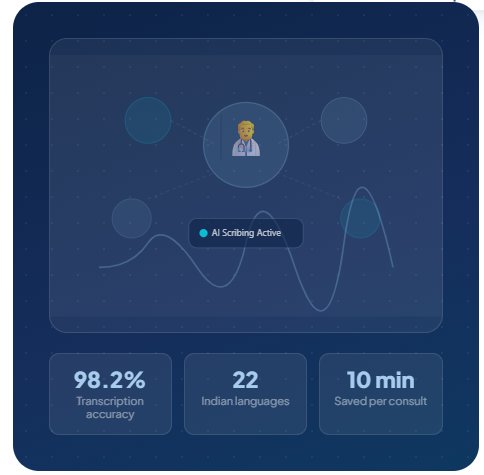
Building a clinical intelligence platform that transforms doctor-to-patient interactions into structured medical knowledge. Capture critical context during consultations, organise clinical signals through deterministic frameworks, and surface continual insights that clinicians can review while retaining full control over medical decisions.
- Built on real Indian consultation data — not Western medical databases
- Physician-controlled at every step — AI assists, doctors decide
- Designed for high-volume OPD environments, not idealised clinic settings
- Data stays in India, always — DPDP and HIPAA compliant from day one
Core Values
Principles that shape every decision, every feature, and every interaction in our clinical ecosystem.

Technology must adapt to how doctors practice medicine, not the other way around.
Physician First

Human Oversight
All outputs remain editable and require physician approval before becoming part of the clinical record.

Built for India
Systems are designed for multilingual consultations, high patient volumes, and India specific healthcare workflows.

Context Awareness
Clinical intelligence must understand language, regional epidemiology, and local healthcare realities

Privacy & Security
Patient data is protected through strong encryption, secure infrastructure, and regulatory compliance
Grow together
We’re not just a software platform we’re a partner in your long-term success.
Top customer fulfilment
Best payment software
Top payment company

Values play a crucial role in shaping our perspective
Our values serve as the foundation for how we interpret the world around us. They influence our decisions, guide our actions
- Clarity Over Clutter
- People Before Features
- Security as a Standard
Healthcare Challenges Qortexa Addresses
Six systemic gaps holding Indian healthcare back — click each to explore the problem and how Qortexa closes it.

Lack of Structured Clinical Data
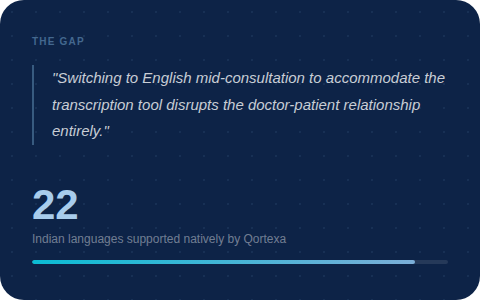
Unstructured medical information limits continuity of care and prevents meaningful healthcare intelligence from being built at scale. Most clinical knowledge exists only in doctors' heads and handwritten notes — inaccessible, non-searchable, and lost over time.

India-Context Ambient Scribing
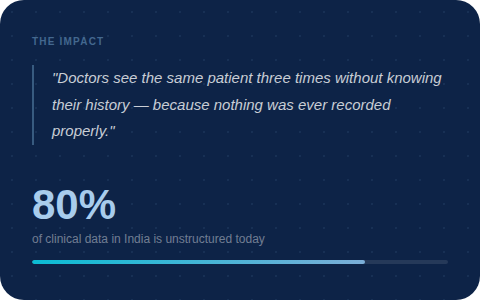
Most ambient documentation tools are built for English consultations and fundamentally struggle with mixed-language clinical conversations common in India. Hindi, Tamil, Telugu, Marathi — real Indian doctors don't speak in one language.

Administrative Burden on Doctors
High patient volumes and growing documentation requirements reduce the time available for patient care. Indian doctors see 60–120 patients a day. Every extra minute on paperwork is a minute taken away from medicine.
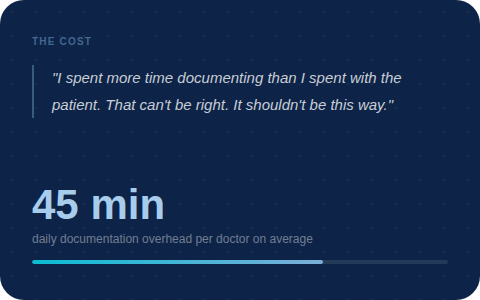

Fragmented Digital Tools
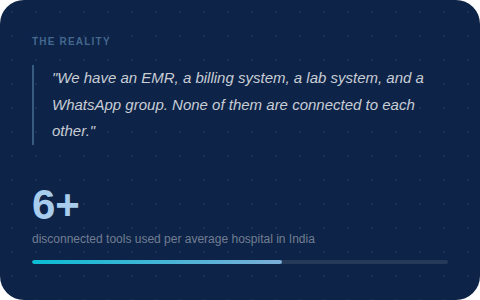
Clinics and hospitals rely on multiple disconnected systems for documentation, analytics, and workflow management — none of which talk to each other. The result is data silos, duplicate entry, and no single source of truth.

Data Sovereignty
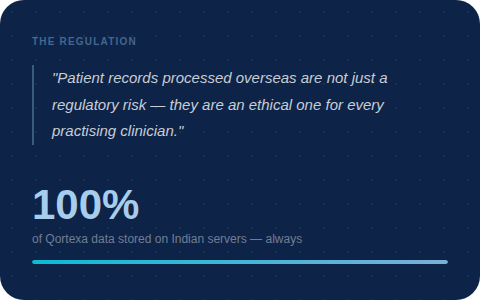
Healthcare data generated in India must remain protected within secure infrastructure aligned with Indian regulations — not stored on foreign servers. The DPDP Act 2023 is unambiguous: patient data belongs to India.

Clinical Knowledge Locked in Conversations
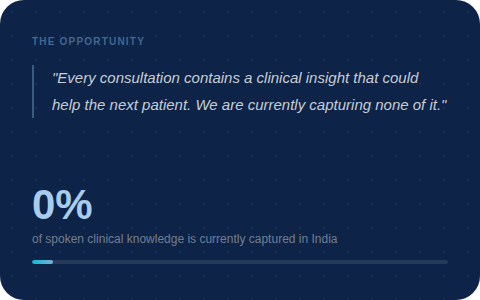
The most valuable clinical intelligence — the nuanced reasoning doctors apply during consultations — disappears the moment the patient leaves the room. Qortexa captures it, structures it, and makes it available across the care continuum.
Lack of Structured Clinical Data
Unstructured medical information limits continuity of care and prevents meaningful healthcare intelligence.

India-Context Ambient Scribing
Most ambient documentation tools are built for English consultations and struggle with mixed language clinical conversations common in India.
Administrative Burden on Doctors
High patient volumes and growing documentation requirements reduce time available for patient care.
Fragmented Digital Tools
Clinics and hospitals rely on multiple disconnected systems for documentation, analytics, and workflow management.
Data Sovereignty
Healthcare data generated in India must remain protected within secure infrastructure aligned with Indian regulations.
Clinical Knowledge Locked in Conversations
Healthcare data generated in India must remain protected within secure infrastructure aligned with Indian regulations.



From our CEO
Dr. Sravya Muddu is a physician and healthcare technology entrepreneur with academic and clinical exposure across infectious diseases, biomedical research, neurosurgery, and community health.
Through her experience across diverse healthcare environments, she observed a fundamental gap in modern medical systems — while medicine increasingly depends on digital infrastructure and data, much of the most valuable clinical information remains trapped in unstructured conversations and fragmented records.
She founded Qortexa to bridge this gap by building systems capable of capturing and organizing real clinical interactions without disrupting the natural workflow of physicians.
Her work focuses on developing healthcare technologies that respect clinical judgment while enabling more efficient medical practice and better use of clinical knowledge.
Dr. Sravya Muddu, Founder & CEO

Dr. Shreya Mukta
Founder & CEO, Qortexa Health Technologies
Building the system Indian doctors deserved — but never had
Dr. Sravya Muddu is a physician and healthcare technology entrepreneur with academic and clinical exposure across infectious diseases, biomedical research, neurosurgery, and community health.
She founded Qortexa to bridge this gap by building systems capable of capturing and organising real clinical interactions without disrupting the natural workflow of physicians. Her work focuses on developing healthcare technologies that respect clinical judgement while enabling more efficient medical practice and better use of clinical knowledge.
Dr. Sravya Muddu, Founder & CEO
SM
Dr. Sravya Muddu
Founder & CEO, Qortexa Health Technologies
Building the system Indian doctors deserved — but never had
“Through my experience across diverse healthcare environments, I observed a fundamental gap in modern medical systems — while medicine is increasingly digitised, the most valuable clinical information remains trapped in unrecorded conversations and fragmented records.”
Dr. Sravya Muddu is a physician and healthcare technology entrepreneur with academic and clinical experience across infectious diseases, biomedical research, neurosurgery, and community health.
She founded Qortexa to bridge this gap by building systems capable of capturing and organizing real clinical interactions without disrupting the natural workflow of physicians. Her work focuses on developing healthcare technologies that respect clinical judgement while enabling more efficient medical practice and better use of clinical knowledge.
Dr. Sravya Muddu
Founder & CEO, Qortexa
Experience a free trial today and
watch your business grow
Sign up today to see how Qortexa can support your practice. No credit card required. No commitment. Just clinical intelligence — ready in minutes.